




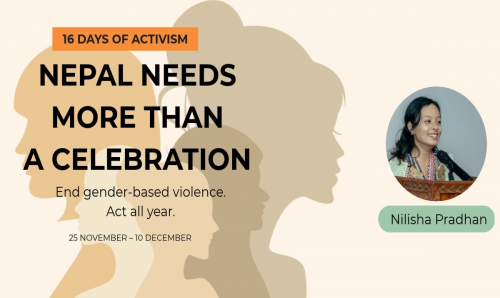
Sixteen Days of Activism, 365 Days of Accountability: Nepal Needs More Than a Celebration
For a person living with violence, concerns may not be focused on the number of speeches, the number of demonstrations or the number of posts on social media. What is crucial is that: When I need assistance will it be provided? Will I be safe? And will things change?


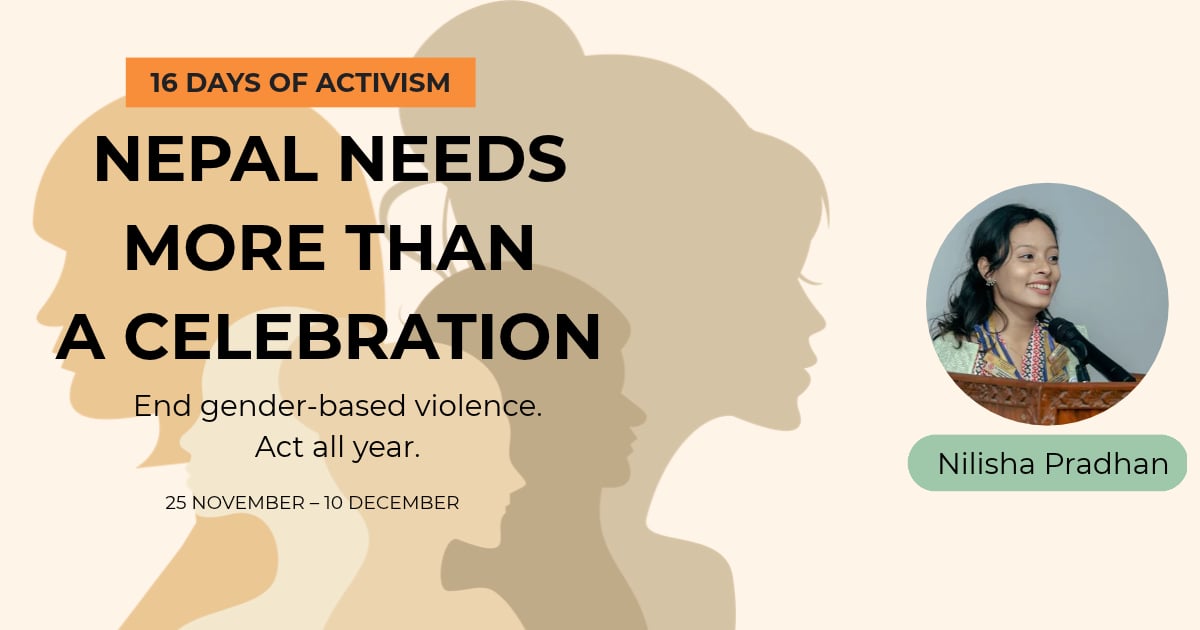
On 25th November 2026 the 16 Days of Activism to end Gender Based Violence commences and continues until 10th December (Human Rights Day). This years’ UNiTE global campaign encourages individuals to "Ensure justice, protect survivors, end impunity." As well as being statements to put on banners, these should underpin the actions taken by governments, organizations, communities and even families, on an ongoing basis. [1]
In Nepal, the campaign should encourage analysis as well as re-affirmation. Are individuals confident in approaching services to obtain assistance? And is there willingness within organizations to hold to account those who have committed acts of violence particularly if they are powerful, highly regarded and/or known to an individual?
Whilst public engagement and demonstration can be valuable for showing unity and to highlight issues that can often be overlooked, observing a campaign is not sufficient in itself. Although 16 days of campaigning can raise awareness, this should not be seen as a replacement for continual year round action to ensure safety, respect and justice.
Global statistics require further action
The statistics are shocking, symbolic campaigning is insufficient. According to reports issued by the World Health Organization and UN partners on 19th November 2025, around 840 million women (almost one in three worldwide) had suffered some form of intimate partner or non-intimate sexual violence in their lifetime. Furthermore, around 316 million women aged 15 and above suffered from sexual violence by an intimate partner in the 12 months prior to the data collection. These are 2023 statistics resulting from surveys and research undertaken between 2000 and 2023 and these do not represent the number of incidents which have arisen in 2026. [2]
Equally alarming are the results of new UNODC-UN Women research published on 24th November 2026. It indicates that in 2025, 47,000 women and girls were murdered by their partner or family member. However, the 2025 figure is lower than that for 2024 and this should not be interpreted as meaning that fewer murders occurred. There has been significant variation in the availability of data and so this has had an impact on the statistics. [3]
Importantly, rather than allowing statistics to become background information, they should influence our analysis. We should investigate the extent to which a campaign effectively supports those at risk. Further, we should analyze which services will continue to be available post-campaign. Finally, who will be held to account if calls for protection are not responded to?
Although global data show that violence occurs worldwide, this does not mean that it should, or will, occur in our own communities. Therefore both prevention and accountability for violence are joint priorities.
The unspoken nature of Nepal’s data
According to the Nepal Demographic and Health Survey 2022, 23% of women aged 15-49 have experienced some form of violence since they were 15. Of these, 8% had suffered sexual violence. Further, 27% of women in this age range who have ever been married or in an intimate relationship had been subjected to physical and/or sexual violence by their current or last husband/ intimate partner. 17% of married women had experienced such violence from their husband/intimate partner in the 12 months pre-survey. [4]
Of particular relevance are the data regarding those who did not disclose or seek assistance following sexual violence. 58% of women did neither. Conversely, 28% had sought assistance in order to end the violence. Again, these are 2022 survey results and so do not indicate the current situation in Nepal. [4]
Importantly, a lack of disclosure should never be seen as acceptance of violence. It should lead to evaluation of the safety of seeking assistance. Campaigns which urge survivors to ‘speak up’ can unintentionally place pressure on them to do so. It is our duty to ensure that there is an appropriate response to such disclosures.
Those affected may experience further dilemmas including: Where will I live? Who will care for my children? How much will it cost me to move? Will my confidentiality be upheld? Will the person to whom I turn inform the offender? And will I be sent away without protection? Awareness raising often fails to address these concerns and so encourages people to put themselves at risk without sufficiently analyzing how society as a whole should share accountability.
Prevention also needs to start at an early age. According to UNICEF’s report in October 2026 which analyzed data from the Nepal Multiple Indicator Cluster Survey 2024-25, 28% of women aged 20-24 were married before they reached 18. Although there has been positive movement over time, the report emphasizes that this improvement has not been equal. Significantly, girls from the most disadvantaged backgrounds have not gained as much benefit. Please note that this relates to child marriage and is not directly connected to, nor should it be conflated with, data surrounding violence. [5]
Taken overall, alongside the statistics, it is essential to provide additional support so that individuals can be protected and to prevent girls’ education, agency and future prospects from being compromised. However, global and Nepal statistics should not be combined and should not be assumed to be directly comparable as they pertain to differing groups, types of violence and timeframes. [2, 4, 5]
Not all violence is physically apparent
Whilst we must cease to only recognize violence once it has resulted in a mark upon the body, the World Health Organization categorizes controlling behaviors and abuse as part of intimate partner violence. As well as causing physical harm, such violence can impact upon someone’s mental health (for example by inducing depression and anxiety) and also disrupt sleeping. Sexual and reproductive health can similarly be adversely affected and children’s health and wellbeing too. Thus, in addition to being a human rights and justice issue, gender based violence is also a key public health priority. [6]
Digital environments must also be addressed. Within its November 2025 campaign announcement the United Nations in Nepal emphasized the damaging effects of abuse, sexual blackmail and unauthorized image sharing. Although violence via a mobile or social media platform may not always be perceived as severe as that which occurs in the physical world, this is not necessarily the case. [7]
Rather than confiscating a girl’s mobile, barring a woman from engaging with digital environments or forcing the victim from public view, protection should be provided in a manner that upholds an individual’s liberty. Imposing limitations on survivors is no replacement for holding offenders to account.
Awareness raising as an important initial step
Demonstrations, school meetings and radio broadcasts can all successfully convey messages. Again, such methods of campaigning should be utilized. Difficulties emerge however when involvement in these activities is erroneously viewed as synonymous with success.
Whilst reports may detail that an event occurred, who attended and what photographs were produced, this does not illustrate whether or not attendees learnt about, or were directed to, sources of assistance. Nor does it show whether or not help was provided or whether institutions altered any detrimental practices. Although photographic evidence can highlight that an event has happened, it does not in itself confirm that protection has been offered.
This is not to discredit or criticize those earnestly involved in running awareness raising campaigns. But greater expectations should be placed upon them. Ideally each element of a campaign should relate to an avenue by which people can be referred for assistance, connect with a trained individual, utilize an operational complaints procedure, access services or engage in a collectively agreed assessment of development.
Similarly, those in positions of authority must adhere to the same principles. It is insufficient to merely denounce violence from a platform and to regard dealing with allegations relating to colleagues or political allies as an irritation. An undertaking is best validated when it can withstand situations in which accountability is difficult.
Nepal already possesses relevant legal provisions. Article 38(3) of the Constitution prohibits violence and exploitation of women. Additionally, the Domestic Violence (Crime and Punishment) Act, 2066 (2009), targets Domestic Violence. These are significant. Nevertheless, their importance should be demonstrated by ensuring that individuals can both be protected and that justice is served. [8, 9]
Ensure support is accessible
Whilst reviewing provision over 16 days, local and rural municipalities should ensure there is good quality and up-to-date referral information regarding health, psychosocial, safe housing and both legal and police provision. Members of staff should understand how to advise people on and, with a survivor’s permission, evaluate the effectiveness of referrals. People should not be expected to create their own support network and at the same time ensure their own safety.
Nepal’s One-Stop Crisis Management Centers (OCMCs) are meant to deliver survivor-informed health provision and also refer to social, legal, police and housing provision. Improving integrated provision is more effective than expecting individuals to independently negotiate different sectors. However, just because a center exists, this does not automatically mean that everybody can easily access it and all relevant provision. [10]
Financial provision should cover essential elements such as transport, private interview areas, staff and referral and monitoring procedures. Local municipalities should focus on how to best enable a survivor to achieve safety. Although promotional material and events are important aspects of campaigns, they should not be viewed as encompassing the entire scope of programs. Monitoring should assess which services are lacking and who is accountable for rectifying this.
Women community health workers, teachers, youth and community bodies can all be engaged in campaigning and referral. They should however all be adequately trained and supported. They should not be asked to investigate abuse, challenge abusers or handle delicate issues without suitable training and oversight.
Initial responses should always be empathetic and non-blaming. The World Health Organization advises that professionals should listen, acknowledge a survivor’s issues and recognize their individuality. They should then assist survivors to access relevant services and social support. Blaming language such as “Why did you stay?” or “What did you do to provoke it?” should never be used. [11]
People should never be forced to apologize in order to preserve family honor or so that an office can classify a situation as having been resolved. Support should focus on safety, choice and dignity. Survivors should also never be required to give evidence – either orally or visually – to show that a campaign has been effective. Survivor experience is not evidence to be showcased.
Prevention in daily life
Prevention is not restricted to an annual occurrence. Within the home, it is important to challenge the notion that somebody can dominate another using fear. Children should be taught about mutual respect, shared parental duties and that no-one has the right to humiliate or violently control another person, even if there is disagreement.
As well as educating girls on avoidance strategies, we should equally educate boys on understanding consent, and recognizing and accepting responsibility. Rather than girls solely being accountable for avoiding potential harm, men should analyze their own behavior. They should also challenge sexist comments and refuse to justify known abusers’ actions.
Schools ought to educate pupils continually on healthy relationships, body autonomy and internet usage. They should also put in place effective, age-appropriate procedures for responding to student concerns. Likewise, employers should ensure that there are discreet avenues for employees to raise issues. Whistle-blowing staff should be shielded from reprisals and all individuals, irrespective of their position within a company, should be treated fairly. Merely encouraging people to share abuse experiences without being ready to effectively respond is insufficient.
Prevention should also ensure girls can continue with their education and avoid coercive early marriage. The World Health Organization 2026 campaign focuses on overturning damaging gender stereotypes, encouraging equitable relationships and involving communities. Political will should also be supported by sustainable financial provision. Again, these focal points need embedding within ongoing strategies and financial provision rather than simply being referenced in November addresses. [1]
Ensure inclusion
Campaign planners need to assess whether women with disabilities, Dalit and indigenous women, young people, older women and those from distant communities can access both information and provision. Although women and girls should remain at the heart of campaigns, support structures should not exclude men, boys and sexual and gender minorities who suffer gender-related abuse. Nobody should be unable to access suitable support due to their identity.
Measure results, not just activity
An enhanced campaign will analyze the impact of its messaging. Has suitable support been provided promptly? Were referrals made safely? Has confidentiality been upheld? Has financial provision been appropriately allocated towards both prevention and support? Have schools and companies successfully put in place trusted procedures?
Whilst disseminating information about a campaign, data should be anonymized. Communities deserve to understand whether organizations are fulfilling their promises. Personal survivor details are unnecessary. Again, feedback should be gathered in a confidential and wholly voluntary manner. It should never be linked to support provision.
Furthermore, analysis of complaints is important. An uptick in complaints could indicate that people now trust services more, even if there has not been an actual rise in abuse. Conversely, a reduction in complaints may stem from increased safety. However, this could also be due to people not feeling able to complain. As previously stated, neither of these trends in themselves demonstrate whether or not a campaign has been successful. Complaint data merely shows what has been brought to a service’s attention and so does not fully represent a community’s abuse levels.
Prior to a campaign’s conclusion, all involved organizations should determine, allocate resources for and appoint somebody/ a team to oversee an enduring post-campaign pledge. A review date should also be fixed. Unfortunately, ‘the campaign has now finished’ should not be the closing sentence.
True evaluation commences after 10th December
Whilst Nepal is not expected to resolve all issues within 16 days, this period should result in more lasting improvements. Ideally, common every day, festive and even challenging out-of-town situations will benefit from enhanced support provision.
Real achievements include survivors attaining safety, schools appropriately dealing with issues, communities refusing to justify abuse and organizations rectifying mistakes. However, we should not delude ourselves into thinking that our good intentions equate to effective protection.
Although 16 days can initiate discussion, only continuous endeavor will give this discussion real value. Let us both seriously and collectively engage with this campaign. Moreover, we should scrutinize our readiness to invest money, modify situations and contest issues and then persevere with these activities.
Above all, Nepal should convey that, whether during or outside of these 16 days, nobody who is subjected to abuse will be isolated and unsupported.
For Support in Nepal
National Women Commission – 1145. The commission operates a free 24 hour helpline which enables people to report gender related abuse and obtain information, as well as support and referrals. [12]
Police emergency – 100. This is the Nepal Police control number. Contact should ideally be made from a secure location or item. [13]
Sources and data notes
1. World Health Organization. (2026). 16 Days of Activism against Gender-Based Violence 2026. Campaign dates, global theme, prevention priorities and the LIVES approach.
2. World Health Organization. (19 November 2025). Lifetime toll: 840 million women faced partner or sexual violence. Findings from the 2023 prevalence estimates, based on surveys and studies conducted during 2000–2023.
3. UN Women Australia. (24 November 2026). Five women killed every hour by a partner or close relative in 2025. Release of UNODC–UN Women findings for 2025; includes the warning against interpreting changes in estimates as a confirmed decline.
4. Ministry of Health and Population [Nepal], New ERA, and ICF. (2023). 2022 Nepal DHS Summary Report. Domestic violence and help-seeking findings, printed page 17. Survey year: 2022.
5. UNICEF Nepal. (October 2026). Ending Child Marriage in Nepal: A decade of data and a call to action. Child-marriage indicator from the Nepal Multiple Indicator Cluster Survey 2024–25.
6. World Health Organization. (18 June 2026). Violence against women. Forms of intimate-partner violence and physical, mental, sexual and reproductive health consequences.
7. United Nations in Nepal. (25 November 2025). Digital Violence Is Real Violence: UN Nepal Calls for Action as 16 Days of Activism Begins. Online abuse, sexual extortion and non-consensual sharing of images; this is a 2025 release, not the 2026 campaign announcement.
8. Government of Nepal. (2015; first-amendment English edition, 2016). The Constitution of Nepal. Article 38(3), rights of women and protection against violence and exploitation.
9. Government of Nepal; International Labour Organization, NATLEX record. (2009). Domestic Violence (Crime and Punishment) Act, 2066 (2009). Legislation addressing violence within the family and protection of victims.
10. World Health Organization, Nepal. (5 September 2025). Nepal initiates adaptation of WHO’s assessment protocol to strengthen One-Stop Crisis Management Centres. OCMC model and its links to health, social, legal, police and shelter services.
11. World Health Organization, Global Health Observatory. (n.d.). First line support in policy. Listening without pressure, respecting autonomy and linking survivors to support.
12. National Women Commission. (n.d.). Report Gender Based Violence: Helpline 1145. Free, round-the-clock helpline and information, counselling, support and referral services.
13. Nepal Police. (n.d.). Contact. Official listing of Police Control: 100.


प्रतिकृया दिनुहोस