




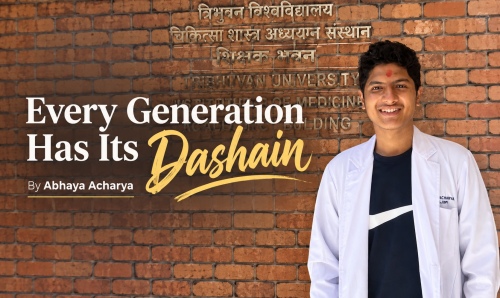
Blog: Every Generation Has Its Dashain
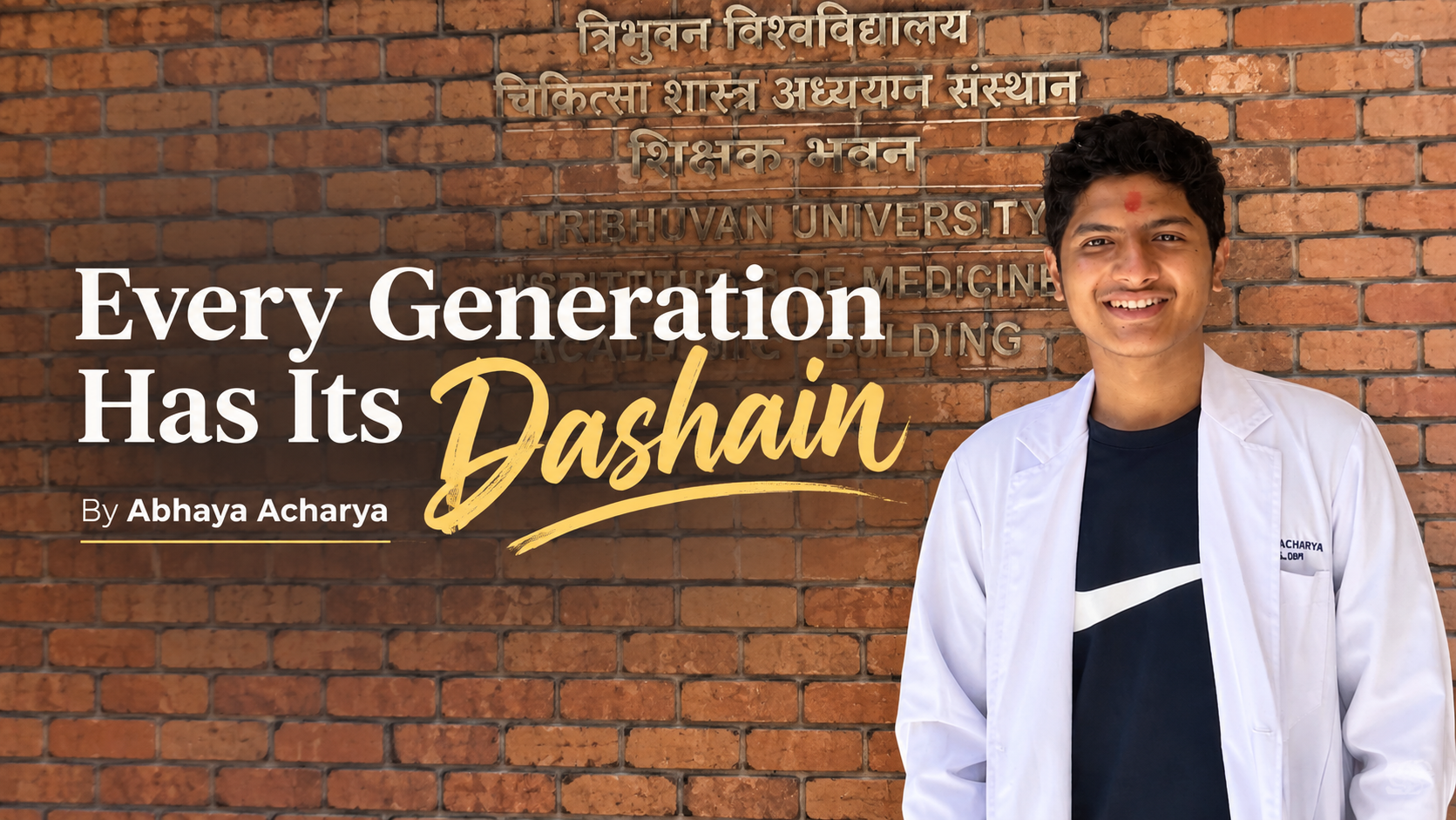
At 23, I find myself looking back at a time when Dashain felt more tangible. There was the excitement of shopping for new clothes in the streets of Asan, the smell of food being prepared, relatives arriving, cards being shuffled, and the long journey back to the village in a bus packed with familiar faces. There was the countdown to tika day, when everything seemed to lead towards one special moment. Even the ordinary things carried a certain significance. For a few days, life appeared to pause, and everything felt different.


But perhaps, when we look back, we are remembering two things at once: Dashain as it was and ourselves as we were when we experienced it.
As children, we did not have to create the excitement ourselves. Someone bought us new clothes, someone prepared the food, and someone arranged the journey. All we had to do was wait for the festival to arrive. As we grew older, we began to see the work behind the magic. We became the ones making arrangements, worrying about expenses, managing work and studies, and trying to coordinate with family members whose lives were moving at different paces. Perhaps the world no longer seems to pause for Dashain as it once did when we were younger.
We often talk about how the younger generation does not experience Dashain the way we did. But every generation inherits a festival without necessarily inheriting the same experience of it. Perhaps every decade creates its own version of Dashain. The festival feels timeless to those living through it, until, gradually, the familiar gives way to something new.
The clothes change, the food remains, the people gathered around the house change, journeys become shorter, and playing cards may no longer be the centre of family gatherings. The old ways are gradually replaced by new ones. Yet, the tradition has not necessarily lost its charm. Perhaps it is the circumstances that once made that charm so familiar that have changed.
For many of us, the magic of Dashain remains in vivid memories of swings swaying in the breeze, journeys to our villages, the taste of home-cooked food, and the warmth of being surrounded by people we love. These memories become even more precious as the years pass, not simply because of what happened during those days, but because of who we were when they happened.
Perhaps one day, the younger generation will look back at its own Dashain and wonder where that particular magic went. They may miss things we do not even consider important today. They may remember small moments that seem ordinary to them now but will eventually become treasured memories. What feels unremarkable in the present may become irreplaceable in retrospect.
And perhaps that is the bittersweet beauty of tradition. We inherit a version of it created by those before us and grow up believing that it is the only way it should be celebrated. Eventually, we discover that we were never meant to preserve it exactly as we found it. We were only its temporary custodians, carrying it forward while adding something of our own.
Dashain may not be what it used to be. But perhaps no Dashain was ever meant to remain the same.
(Abhaya Acharya is a fourth-year MBBS student at the Institute of Medicine (IOM), Maharajgunj Campus)







प्रतिकृया दिनुहोस